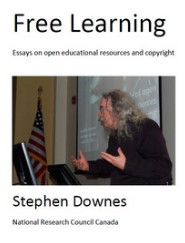


Stephen Downes

Knowledge, Learning, Community

Select a newsletter and enter your email to subscribe:

Email:

Vision Statement

Stephen Downes works with the Digital Technologies Research Centre at the National Research Council of Canada specializing in new instructional media and personal learning technology. His degrees are in Philosophy, specializing in epistemology, philosophy of mind, and philosophy of science. He has taught for the University of Alberta, Athabasca University, Grand Prairie Regional College and Assiniboine Community College. His background includes expertise in journalism and media, both as a prominent blogger and as founder of the Moncton Free Press online news cooperative. He is one of the originators of the first Massive Open Online Course, has published frequently about online and networked learning, has authored learning management and content syndication software, and is the author of the widely read e-learning newsletter OLDaily. Downes is a member of NRC's Research Ethics Board. He is a popular keynote speaker and has spoken at conferences around the world.

Stephen Downes Photo
Stephen Downes, stephen@downes.ca, Casselman Canada

Why Authoritarian Innovation Has Limits: A Recursive Emergence Perspective | Isaac+Mao
78618 image icon

While Isaac Mao is talking about innovation at the national level, and specifically China, I think the same logic applies at corporate and institutional levels. Innovation, says Mao, is a process where "collective memory (Ψ) generating new coherent patterns (Φ), which reshape the institutional lattice (Ω), which then feeds back into memory with less entropy than before," and this requires "high Ψ diversity... high Ω permeability (and) fast Φ→Ψ integration" (or, in my own terms: diversity and autonomy, openness, and interaction, respectively). In other words, 'recursive emergence'. A discussion based on this follows, but I think it should be more nuanced. No government (or corporation or institution) is completely authoritarian or non-authoritarian, and they can be more or less authoritarian in different areas. And we are not (yet, at least) globally authoritarian. But the main point here is the definition of innovation, and I think this is not wrong, and I think a lot about how we should structure business, research and society follows from this.

Today: Total: Isaac Mao, Recursive Emergence, 2025/12/18 [Direct Link]
Can neuroscientists decode memories solely from a map of synaptic connections?
78617 image icon

My inclination is to answer this question with a "no" while I think the panel's collective response is to say "do what now?" Because, after all, what exactly is is to decode a memory?"I think," says Michał Januszewski, "that you want to do, if you want to read out a memory, is to have a learned function which maps some inputs to some outputs." So anything that is a 'memory' will be relative to a specific input? Or do we just generalize, and say any future (brain) state that depends on a past state is a memory. But then, is a behaviour (like a bird singing its song) a memory? There's a lot more along these lines; if you're in education, you should at least consider some of these questions. You can read the transcript (16 page PDF) or listen to the panel discussion as a video. 

Today: Total: The Transmitter, 2025/12/18 [Direct Link]
Facebook tests £9.99 monthly subscription for sharing more than two links
78616 image icon

As this article reports, "Facebook is testing placing a limit on how many links some users can share when they post on the social media platform." I'm sure I don't need to emphasize how anti-Web this is. "Tests like this underline why building a business that's overly dependent on any one platform's goodwill is incredibly risky." Even more to the point, it underlines why we shouldn't depend on centralzied servcies at all.  See also: the Guardian.

Today: Total: Liv McMahon, BBC, 2025/12/18 [Direct Link]
Protecting online safe spaces
78615 image icon

I'm a bit surprised to read that Zoom-bombing is still a thing. "'Zoom-bombing' refers to any time uninvited guests join a virtual meeting to disrupt it, typically by sharing loud audio or offensive imagery, or both." That said, I have worked with professors who even as late as this year have preferred to keep their Zoom chat open to whomever wants to drop in. It's definitely not what I recommend, no more than I would recommend allowing just anyone to join the stage at a conference panel discussion. At the same time, I've seen the logic work in reverse, which professors arguing that the discussion shouldn't be advertised so they can keep it 'open' without fear of it being Zoom-bombed. Me, I don't really see a contradiction of values here - 'open' does not entail a responsibility to provide an 'open mic'.

Today: Total: Alana Cattapan, University Affairs, 2025/12/18 [Direct Link]
Teaching Quality
78614 image icon

This is quite a long post and it wanders into irrelevant territory quite a bit (for example, a debate on whether liberal or conservative instructors are better teachers) but the message, ultimately, is quite clear: "If universities continue to charge premium tuition for sub-par human instruction that is inferior to a $20/month AI subscription, the market will collapse." So what to do? "The only survival strategy is to offer what AI cannot: the 25% of 'heroic' teachers who provide mentorship, complex critique, and the human accountability that drives actual learning." This, however, requires definition and measurement of teaching quality, and the data for this just isn't there. Hollis Robbins isn't the first to stress teaching quality in higher education, but I still think the concept is more elusive than critics think. Because if it weren't, we'd have some was of measuring it, and if we could, then we'd just have AI optimize for that. As Justin Weinberg says, "calling for a metric that will reduce all the various things a university can do for students to a few numbers does not seem like a promising strategy."

Today: Total: Hollis Robbins, Anecdotal Value, 2025/12/18 [Direct Link]
Coursera and Udemy enter a merger agreement valued at around $2.5B
78613 image icon

My interest in the world of mergers and acquisitions is virtually zero, but I'll pass along this notice because I imagine some people interested in MOOCs and edtech will want to take note. The announcement states, "they have entered into a definitive merger agreement under which Coursera will combine with Udemy in an all-stock transaction." If you're wondering about the layoffs that inevitably follow such an announcement, they anticipate "annual run-rate cost synergies of $115 million within 24 months of closing", so what's that, a thousand jobs, maybe a quarter of their combined workforce? The announcement also suggests "sustained investment in AI-driven platform innovation, rapid product development, and durable growth initiatives." 

Today: Total: Lauren Forristal, TechCrunch, 2025/12/18 [Direct Link]

Stephen Downes Stephen Downes, Casselman, Canada
stephen@downes.ca

Copyright 2025
Last Updated: Dec 19, 2025 01:37 a.m.

Canadian Flag Creative Commons License.